
The lowest quote is not necessarily the best contract. To understand how to choose a contract cleaning company, assess the quoting process, written scope, cleaning standards and service oversight together. Choose a provider whose proposal explains what will be done, how performance will be monitored and how communication will work when site requirements change.
Comparing proposals is difficult when they cover different tasks or levels of oversight. A clear scope lets you assess what the service includes and whether it suits your facility. Cleaning needs differ between offices, factories, retail spaces and shared residential buildings, so the proposal should reflect the site rather than rely on a generic task list. This guide explains how to assess a quotation, agree measurable expectations and evaluate client service before signing. You’ll be better placed to decide based on operational fit, not price alone.
Key Takeaways
- Assess whether a written quote defines the work, service frequency and any tasks treated as extras.
- Look for clear cleaning standards and a process for monitoring performance across the site.
- Agree how updates, service issues and changing facility needs will be handled.
- Match the service scope to your type of property and its day-to-day cleaning requirements.
Booking and quoting processes
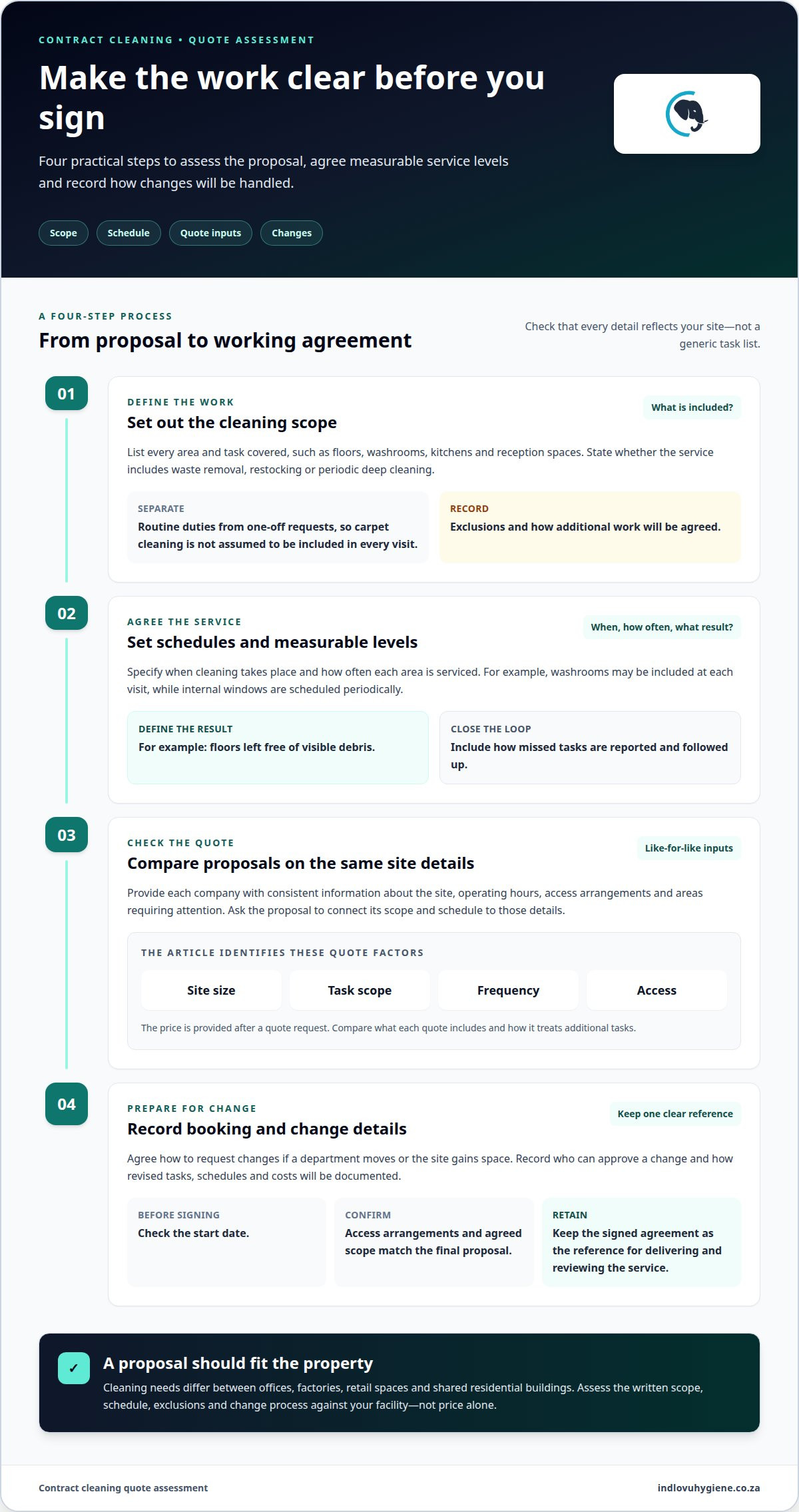
A contract cleaning agreement should define the work, schedule, service levels and process for recording changes. To decide how to choose a contract cleaning company, start by checking whether its proposal reflects your site.
-
Set out the cleaning scope
List each area and task covered, such as floors, washrooms, kitchens or reception spaces. Specify whether the work includes waste removal, restocking or periodic deep cleaning. Separate routine duties from one-off requests so carpet cleaning is not assumed to be part of every visit. Record exclusions and how additional work will be agreed. This gives both parties a clear reference for service delivery.
-
Agree schedules and service levels
Specify when cleaning takes place and how often each area is serviced. For example, washrooms may be included at each visit, while internal windows are scheduled periodically. Define the expected result for each task, such as floors left free of visible debris. Include how missed tasks are reported and followed up. These measures make it easier to assess performance against the agreement.
-
Review how the quote is built
Provide consistent details about the site, operating hours, access arrangements and areas requiring attention. Ask for the proposal to connect its scope and schedule to those details. The price depends on site size, task scope, frequency and access, and is provided after a quote request. When deciding how to choose a contract cleaning company, compare what each quote includes and how it treats additional tasks.
-
Record changes and booking details
Agree how to request changes if a department moves or the site gains space. Record who can approve changes and how revised tasks, schedules and costs will be documented. Before signing, check that the start date, access arrangements and agreed scope match the final proposal. Keep the signed agreement as the reference for delivering and reviewing the service.
Maintaining consistent cleaning standards
Set measurable checks for completed work, staff accountability and site-specific procedures. Use the agreement to define how standards are reviewed and issues corrected.
- Define how supervisors verify completed tasks. Use a site checklist that records the area, task, inspection result and any corrective action. For example, a washroom check can cover visible cleanliness, replenished supplies and reported faults. A clear record helps identify recurring gaps rather than relying on general impressions.
- Compare equipment and products with the facility’s surfaces and tasks. Request a written list showing which equipment and cleaning products are used, where they are applied, and how staff follow product instructions. Compare providers’ approaches to product use, packaging and waste handling with your organisation’s environmental practices.
- Set a process for reviewing performance over time. Agree how inspection findings are recorded, who receives reports and how repeat issues are escalated. For a facility with several buildings, use the same core measures at each site while recording local task differences. This supports consistent oversight without treating every space as identical.
- Identify the legal duties named in the agreement. According to PRASA CRES, its contract template requires the cleaning service provider to perform its duties in accordance with South Africa’s Occupational Health and Safety Act, 1993 (Act no. 85 of 1993). Record relevant contract obligations clearly, and distinguish them from any licence or registration requirement.
- Review liability cover against the contract’s stated requirements. For a PRASA CRES contract, the service provider must give PRASA CRES a copy of its public liability insurance policy within 7 days after the effective date. Record the responsible party and submission deadline in the contract, then retain the policy copy with the service records.
Use these checks to guide a discussion of cleaning requirements for your facility.
Professionalism and client service
Assess how the company communicates, manages staff and resolves service issues. Use these checks to determine whether its operating practices suit your site.
-
Check references and experience
Request references from South African clients with facilities similar to yours. Offices, factories and shared residential buildings have different access and cleaning demands. Ask referees about service continuity, supervisor contact and how reported problems were handled. Compare their examples with the work described in the proposal. A reference that only confirms a working relationship offers less insight into day-to-day performance.
-
Assess staff practices
Ask the company to explain how it prepares cleaners for assigned tasks, checks staff suitability and supervises site work. Look for a clear induction process, task instructions and a named point of supervision. Discuss how staff receive guidance on safe equipment and product handling. For example, cleaners entering restricted areas should understand the site’s access procedures before carrying out duties there.
- Agree how communication will work once service begins. Set regular check-ins with a named contact, and define how staff report completed work, access issues or recurring defects. A short review can cover open tasks, feedback and changes to site use. Record decisions and responsibilities so instructions are not left in informal messages or passed between people without ownership.
- Watch for warning signs in the proposal and follow-up. Vague answers about supervision, unclear responsibility for complaints or reluctance to document agreed changes can make service harder to manage. A very low quote without a clear explanation of scope also deserves scrutiny. Compare the stated work and oversight with your operational needs instead of treating price as proof of value.
- Use a practical communication test before appointing a provider. Send a specific query about a site requirement and note whether the response addresses it directly. Check that the answer identifies the next action and responsible contact. Clear, consistent communication during selection helps set expectations for handling service concerns once the contract is active.
What services should a contract cleaning company provide in South Africa?
Match the service scope to the facility’s daily use. Offices, factories and shared buildings may need different routines, specialist tasks and reporting.
- Include routine cleaning for areas people use every day. Specify tasks such as dusting, floor care, washroom cleaning, waste removal and high-touch surface cleaning. For example, a reception area may need attention before opening, while a low-traffic store room may require less frequent cleaning. Link each task to its location and required frequency.
- Define washroom hygiene and consumable responsibilities separately. State whether the service includes cleaning, replenishing supplies and reporting low stock. Clarify how waste removal and recycling fit the site’s disposal arrangements. This prevents routine cleaning from being confused with supply management or building operations.
- Identify periodic work beyond the regular schedule. Floor and carpet care, window cleaning and deep cleaning can address needs that daily routines do not cover. Name the areas and work required, such as periodic carpet care in meeting rooms. Keep these tasks distinct from the recurring schedule so their timing and expected results remain clear.
- Match specialist work to the facility. A factory may need cleaning procedures suited to its working areas, while a retail space may prioritise customer-facing floors. Agree which equipment and expertise the provider brings for each task. Include access constraints, sensitive surfaces and operational areas in the site plan so the agreed methods suit the premises.
- Include reporting and ongoing maintenance planning in the service discussion. Ask for cleaning performance reports that show completed work, recurring issues and corrective actions. For a facility with several locations, consistent reporting helps compare performance across sites. Agree how the service scope can be reviewed as occupancy, building use or maintenance needs change.
Request a contract cleaning proposal that reflects your facility’s service requirements.
Indlovu Hygiene Solutions: Office Cleaning
Indlovu Hygiene Solutions provides Office Cleaning and Contract Cleaning for businesses that need a defined, recurring arrangement. Its services also include Factory / Industrial Cleaning and Body Corporate Cleaning for different premises and shared spaces.
Turn to Indlovu Hygiene Solutions when your current cleaning arrangements are difficult to coordinate or your facility needs a consistent service scope. Start by outlining the areas requiring attention, the tasks involved and your preferred cleaning schedule. This gives the service discussion a practical starting point and helps align the proposed work with your site’s day-to-day requirements.
Contact Indlovu Hygiene Solutions to discuss cleaning requirements for your premises.
Set up a clear next step
Before signing, decide who in your organisation will manage the cleaning relationship and which operational outcome matters most. A facilities lead may prioritise predictable access, while a commercial director may focus on consistent delivery across sites. Naming an accountable decision-maker keeps approvals, feedback and future decisions connected.
Use these priorities to decide how to choose a contract cleaning company in a way that fits your organisation’s governance. Involve procurement, facilities and relevant site teams in the final decision. Their combined perspective can identify practical constraints that a proposal alone may not reveal. It also gives those responsible for the site a clear role in putting the arrangement into practice.
If you are deciding how to choose a contract cleaning company for your premises, Indlovu Hygiene Solutions can discuss your cleaning requirements. Contact Indlovu Hygiene Solutions to begin that conversation and take a considered next step.
Frequently Asked Questions
How much does contract cleaning cost in South Africa, and what affects the price?
The price depends on the site and is provided after a quote request. Key cost factors include the areas covered, cleaning tasks, service frequency, access arrangements and any specialist work. For example, a facility needing routine floor care and periodic carpet cleaning has different requirements from one needing routine tasks alone. A clear scope helps ensure the proposal reflects the actual service.
How do contract cleaning quotes compare: hourly rates, per-square-metre rates and fixed fees?
Compare the work covered, not just the pricing unit. An hourly rate relates the charge to time, a per-square-metre rate to measured area, and a fixed fee to an agreed service package. Check whether each proposal covers the same tasks, frequency and site areas, and treats additional work in the same way. For example, a fixed fee may be hard to compare if one quote excludes periodic floor care.
What questions should I ask before hiring a contract cleaning company?
Ask who will supervise the work, how staff receive site instructions and how service changes are recorded. Establish who handles access arrangements and receives operational updates. You can also ask which supporting documents are available for procurement, such as a written service-level agreement, risk assessments or public liability insurance. These questions clarify accountability before work begins.
How do I monitor cleaning quality and handle complaints or missed work?
Use a service log to record the affected area, task, date reported, person responsible and follow-up outcome. For example, note a missed washroom restock separately from a floor-cleaning concern. Send the record to the agreed contact and review unresolved items at the next service check-in. This creates a traceable basis for identifying repeat issues and agreeing corrective action.
What licences, registrations and legal requirements apply to cleaning companies in South Africa?
For a PRASA CRES contract, the cleaning provider must perform its duties in accordance with South Africa’s Occupational Health and Safety Act, 1993 (Act no. 85 of 1993).