
A cleaning schedule works best when the duties, timing and payment terms are clear. Scheduled contract cleaning services define the agreed tasks, how often they are carried out and each party’s responsibilities. A written agreement gives the property owner or manager and the cleaning provider a shared plan for the work.
Whether you’re arranging cleaning for a home or commercial site, the scope depends on the space and its needs. A proposal can list specific tasks, while the agreement sets out the schedule, payment arrangements and how changes are handled. The cost depends on the premises, required work and cleaning frequency, and is provided after a quote request.
This article explains what a cleaning service can include, how proposals and payment terms work, and what to arrange for site access and requirements. It also compares residential and commercial cleaning, helping you assess how a recurring service could suit your premises.
Key Takeaways
- Use the written agreement to define cleaning duties, inspection expectations and how incomplete work is addressed.
- Compare proposals by checking the task scope, service frequency and payment arrangements against your premises’ needs.
- Set out access procedures and communicate the site’s health, safety and security requirements before cleaning begins.
- Match the cleaning schedule to how the property is used, whether it is a home, office, factory or shared residential building.
Contract duties and payment terms
A written agreement defines the cleaning provider’s duties, the client’s responsibilities, payment terms and scheduled work. These terms clarify how service delivery, costs and changes are managed.
Contractor duties and client obligations
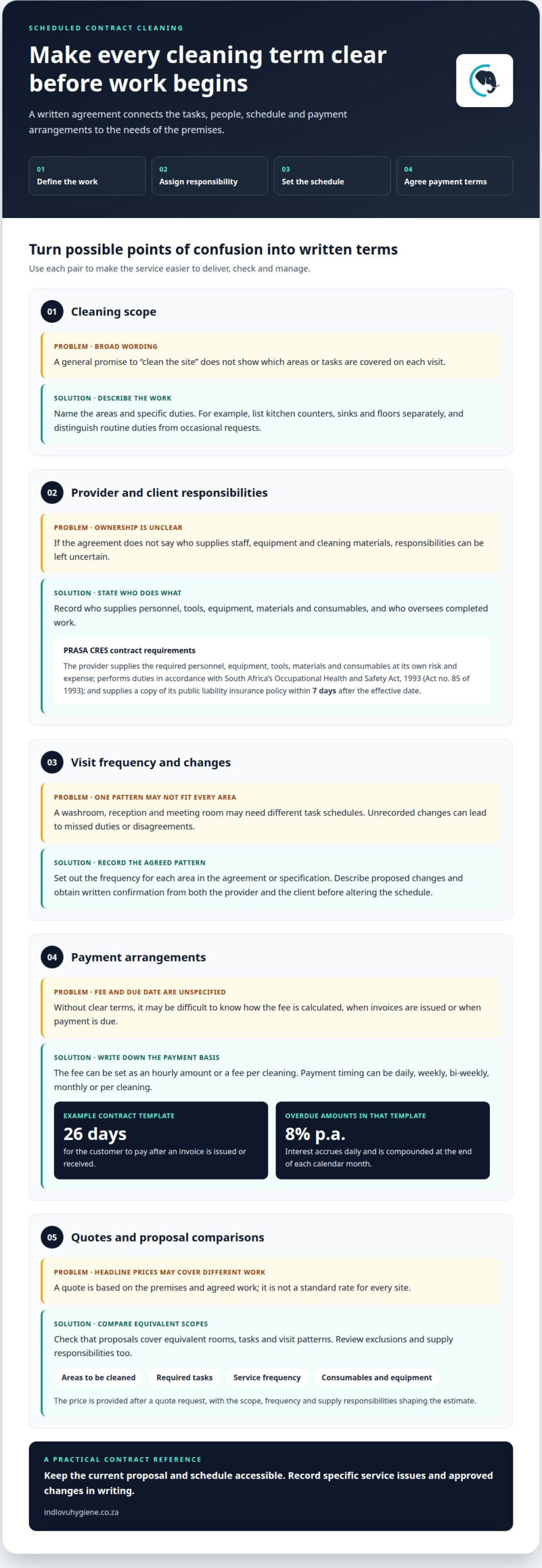
The contract records who supplies staff, equipment and materials, and who oversees completed work. Under PRASA CRES terms, the provider supplies the personnel, equipment, tools, materials and consumables needed, at its own risk and expense. The provider must perform its duties in accordance with South Africa’s Occupational Health and Safety Act, 1993 (Act no. 85 of 1993), according to the Government of South Africa. For PRASA CRES, the provider must also supply a copy of its public liability insurance policy within 7 days after the effective date. Licence requirements depend on the work and applicable rules. For this PRASA CRES contract, the stated insurance and safety duties form part of the service requirements.
For PRASA CRES, the provider supplies cleaning products and equipment, including the soaps, detergents and polish required by the RFQ specifications. Contract terms should clearly state who is responsible for supplies.
Payment arrangements
Payment arrangements state how the fee is calculated, when invoices are issued and when payment is due. A contract can set compensation as an hourly amount or a fee per cleaning. It can also specify payment daily, weekly, bi-weekly, monthly or per cleaning. One cleaning services contract template gives the customer 26 days to pay after an invoice is issued or received. It provides for interest at 8% per annum on overdue amounts, accruing daily and compounded at the end of each calendar month. Clear terms help both parties manage invoices and identify overdue payments.
Prices and cleaning quotes
A quote reflects the agreed work for the premises, not a standard rate for every site. Cost depends on the areas to be cleaned, the required tasks, service frequency, and whether the provider supplies consumables and equipment. For example, a schedule covering a kitchen and washroom differs from one covering only a few shared areas. The price is provided after a quote request, with the scope, frequency and supply responsibilities shaping the estimate.
Scheduling cleaning visits
Scheduled cleaning can be set up as a recurring service, with the frequency for each area recorded in the agreement or relevant specification. A washroom, reception and meeting room can each have a different task schedule. Under the PRASA CRES contract, the RFQ specification sets cleaning frequencies for different areas. Any schedule change requires written confirmation from both the provider and the client. Recording the agreed pattern helps prevent missed duties and disputes about changes.
Cleaning service proposals
A proposal turns the premises’ cleaning needs into a defined scope and recurring work plan. In South Africa, scheduled contract cleaning services specify the tasks and timing agreed for ongoing cleaning.
Scope of scheduled cleaning services
A proposal should describe the areas to be cleaned, the included tasks and how the work is organised. Specific tasks, such as bathroom cleaning, are easier to assess than a general promise to clean. Depending on the property, the scope might include laundry, bathroom cleaning and kitchen chores. An office proposal, for example, could distinguish kitchen surfaces from shared meeting rooms. Clear descriptions show what each scheduled visit covers.
Use the proposal to separate routine duties from occasional requests. A kitchen task list could specify counters, sinks and floors, while laundry may need separate handling. A defined scope gives both parties a reference for reviewing completed work and discussing changes.
Arranging a cleaning contract
Arranging a contract means turning the proposal into a written agreement that records the chosen tasks, schedule and responsibilities. This links the expected service to the premises and the people responsible for access. Start by describing the property and how it is used, then identify priority areas and tasks. A household might prioritise bathrooms and laundry, while a workplace may focus on shared facilities.
Compare proposals on equal terms: check that each covers equivalent rooms, duties and visit patterns. Review exclusions and responsibilities as well as included work, so differences are clear rather than hidden in broad wording. Comparing the scope helps you assess the proposals beyond their headlines.
Managing the cleaning contract
Managing a contract means checking delivery against the agreed scope and recording changes. Written records help address missed tasks and prevent informal requests from becoming disputed expectations. Keep the current proposal and schedule accessible to the person overseeing the premises. Note specific issues, such as an uncleaned kitchen surface, along with the date and area.
For a requested change, describe the variation and its intended effect before the work is altered. A revised task list can identify added rooms, removed duties or a different sequence. Under the cleaning services contract template, schedule changes require written confirmation from both parties.
To compare cleaning companies in South Africa, assess proposals against the same rooms, tasks, schedule and responsibilities. To arrange and manage a contract, agree the scope in writing, assign a site contact and document approved changes. A clearly described cleaning service scope gives the working arrangement a practical reference.
Client access and responsibilities
The cleaning services contract template places cleaning activities at the client’s address. The agreement should identify the premises and areas covered, such as reception, a staff kitchen or washrooms. This gives the cleaning team a defined work location and distinguishes authorised areas from restricted spaces.
The customer must inform the provider about the health, safety and security rules, regulations and requirements that apply at the premises. Explain procedures such as signing in at reception, avoiding restricted records rooms and following site-specific protective measures. A written briefing gives cleaning personnel clear instructions before they begin the agreed work.
Access arrangements should state who authorises entry, how cleaning personnel enter and where supplies may be stored. Specify whether they sign in at reception, report to a security office or use another approved entrance. In a shared building, name the contact responsible for access to common areas. These details help avoid interruptions and clarify who can grant entry.
Before the first scheduled visit, the site contact can prepare an access record covering practical arrangements:
- Entry points, sign-in procedures and the reception or security contact.
- Restricted rooms, sensitive equipment and areas excluded from the cleaning scope.
- Alarm procedures, access devices and approved storage areas for cleaning materials.
- The site contact who receives service updates and reports access changes.
For example, an office manager can identify a locked records room and direct the team to clean shared work areas only. At home, the owner can specify which rooms are included and which remain private. Put changes to access or site rules in writing and ensure the responsible contact communicates them before the next visit.
If the client provides property for use during the agreement, record what was issued and its condition. The sample contract requires the cleaner to return client-provided property when the agreement ends. A simple record of keys or access devices supports an orderly handover and helps both parties keep track of them.
Commercial and residential cleaning
Recurring cleaning serves homes and workplaces, but their different uses create different priorities. A household may focus on kitchens, bathrooms and living areas, while a commercial site may prioritise shared facilities and customer-facing spaces. Scheduled contract cleaning services are most useful when the visit pattern reflects how the property is used.
At home, cleaning priorities can follow household routines. A proposal might include bathroom surfaces, kitchen floors and laundry, with less-used rooms handled differently. A change in occupancy, such as a move or renovation, can also alter the required tasks. Residential schedules centre on household needs and access to private rooms.
Commercial schedules need to account for work activities and how people use the premises. A retail space, for example, may need attention to customer areas, staff facilities and floors, while a factory has different operational spaces and cleaning priorities. The agreement should distinguish areas by use so routine tasks support the property’s operations.
Cleaning frequency depends on room use, foot traffic and the work required in each area. A shared washroom may need a different schedule from a meeting room used occasionally. A cleaning contract can assign different frequencies to separate areas instead of treating the property as one space. This aligns service visits with practical needs.
Commercial and residential cleaning can also differ in scale and oversight. A home may have one household contact, whilst a business may need a facilities manager to coordinate access and review completed tasks. The PRASA CRES contract for deep cleaning and sanitising coaches at Blue Shed covers 36 months, illustrating how a defined commercial requirement can operate over a longer service period.
For homes or workplaces that need a recurring arrangement, discuss a suitable cleaning schedule based on the property’s rooms and use.
Indlovu Hygiene Solutions: Office Cleaning
Indlovu Hygiene Solutions provides Office Cleaning and Contract Cleaning for premises requiring a defined recurring service. Its services also include Factory / Industrial Cleaning and Body Corporate Cleaning, for different property types and operational needs.
These services can suit an office that needs regular attention to work areas, or a factory or shared residential building that needs cleaning planned around its premises. A clear scope aligns duties with the spaces in use and the required schedule.
For a commercial site with ongoing cleaning needs, Indlovu Hygiene Solutions can discuss the relevant service and how it fits the property. Contact Indlovu Hygiene Solutions to discuss your cleaning requirements.
Put a clear cleaning plan into operation
A cleaning agreement should remain a practical reference as your premises and daily operations change. Review the scope when room use shifts, new areas come into service or priorities change. This keeps scheduled contract cleaning services aligned with the property instead of relying on informal expectations that may become unclear.
Indlovu Hygiene Solutions offers Office Cleaning, Contract Cleaning and Factory / Industrial Cleaning. These services support offices and operational sites that need a defined cleaning arrangement. To start the discussion, outline your premises, priority areas and routine cleaning needs.
Move your cleaning plan forward with a clear brief. Contact Indlovu Hygiene Solutions to discuss the cleaning requirements for your premises. A well-defined scope gives you a sound basis for planning the next stage.
Frequently Asked Questions
What is a Cleaning Service?
A cleaning service is work carried out to maintain cleanliness in a home or workplace. It can be a one-off visit or a recurring arrangement, depending on the property’s needs. A household might arrange regular cleaning for living areas, while a business could schedule upkeep for its premises. The agreed scope defines the spaces and tasks included.
What cleaning tasks are typically included in a contract cleaning service?
Tasks depend on the premises and agreed scope. A contract might cover routine cleaning in offices, shared residential spaces, retail premises or factories. A building manager could prioritise common areas, for example, while an office could include meeting rooms and staff facilities. The written task list should distinguish regular duties from specialist work, so the service meets the property’s requirements.
How much does contract cleaning cost in South Africa?
Contract cleaning prices depend on the premises, required tasks, visit frequency and supply arrangements; a price is provided after a quote request. For Gauteng premises in Edenvale, Sebenza, Bedfordview, Greenstone, Kempton Park, Benoni, Boksburg, Sandton, Bryanston, Fourways, Midrand, Centurion, Rosebank, Wynberg, Northcliff or Houghton, the property’s scope and operating needs shape the quote. Describing the areas and duties clearly helps define the work being priced.
What should a contract cleaning agreement include?
A cleaning agreement should identify the premises, cleaning duties, service schedule, payment arrangements and each party’s responsibilities. It should also explain how incomplete work is handled, how schedule changes are approved and how scope variations are recorded. If a tenant area is added, for example, written agreement can clarify the revised duties. Clear terms give site managers a reference for overseeing the work and resolving practical disagreements.